Saturday, September 15, 2007

MAIN PROFESSIONAL EXPERIENCES

cJanuary 2007 – today
Editor-in-chief
Capricho magazine (São Paulo, SP - Brazil)
When Capricho's former editor-in-chief was invited to assume a higher position in the company, I was invited to become editor-in-chief of the magazine. I'm now responsible for a team of 22 people, both involved with writing and editorial design.

January 2006 – December 2006
News and Features Editor
Capricho magazine (São Paulo, SP - Brazil)
Capricho is Brazil's most traditional teenager magazine. In 2006, I was invited to join a team that was about to develop and implement a new editorial project for the magazine. As the News and Features Editor I was deeply involved in the creation of new sections and my main concern was to be able to bring new subjects and approaches that would broad the universe of a 15/16 year old girl.
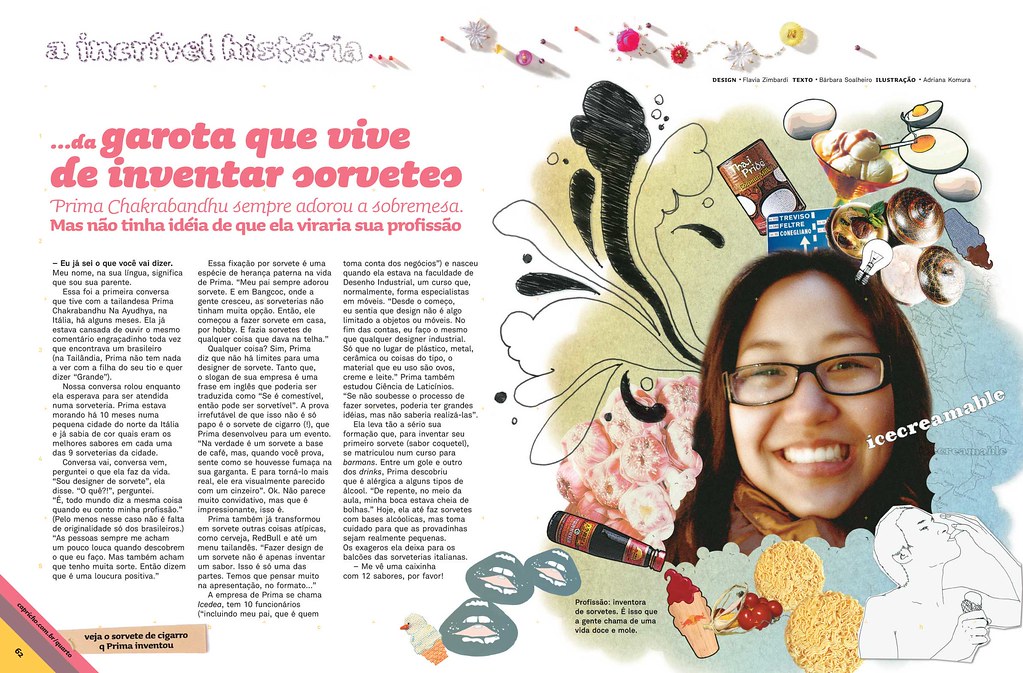
"1,2,3,4", a visual section showing 4 different objects under the same theme is definately inspired by the ideal of celebrating the differences that Colors has held since its creation. And "The Incredible Story of..." intends to tell the stories of girls or guys from around the world with a life that was either exciting or very different from the reality of our readers (the example bellow tells the story of an ice-cream designer).

January 2004 – January 2006
Assistant Editor
Superinteressante magazine (São Paulo, SP - Brazil)
Superinteressante is a popular science magazine (similar to the Italian Focus, although it has a broader range of subjects). Because it's directed to a young audience, texts published by Superinteressante manage to balance deep research and a good amount of humour. As well as writing and investigating stories, my job was to edit three of the magazine’s sections. My favorite, called "What if", aimed to present an imagined scenario to the readers, always based on information and speculation from specialists deeply involved with the subject (the magazine cover showed bellow, for example, is the result of the always uptodated question "what if drugs were legal?")


March 2003 – August 2003
Screenwriter
"No Capricho" TV Program - Prodigo Production Company/MTV Brazil (São Paulo, SP - Brazil)
I was hired to write the screenplay for a 2 minute beauty and fashion show exhibited on MTV daily. The show purpose was to give teenagers tips on trends, beauty and fashion in a cool and young way.

January 2000 – November 2001
Trainee reporter
Palavra (Belo Horizonte, MG - Brazil)
Created by cartoonist and writer Ziraldo (famous for children’s books e.g. "Flicts" and "Menino Maluquinho"), Palavra used to focus on Brazilian regional culture – an unusual subject in a country that has quite a lot of inferiority complex – and my job was to help journalist Wagner Merije to map the cultural activities that were going on in every one of the 27 states of Brazil. Although Palavra launched its last edition in August 2000, the magazine is still remembered for its relevancy in the editorial scenery of Brazil.

INDEPENDENTE WORK (writing)

Como Fazíamos Sem...
In June 2006, my first book -
Como Fazíamos sem... (which means "How did we live without...") - was published. It's a non-fictional book with a collection of 30 stories on objects and concepts that are very ordinary nowadays such as cutlery, soap, surnames, divorce, glasses. The stories tell the history of these objects and how life used to be without having them around.
Como Fazíamos Sem... was an editorial success for Brazilian standards. It's on it's second edition now and, in August of 2007, it was awarded with the
bronze medal on the category of Paradidactic Books of Prêmio Jabuti, Brazil's most important literature prize.


Mininas
Mininas is a pocket magazine that gathers texts from volunteer authors trying to print a poetic, seductive and funny portrait of women. It's benefited with Brazilian Federal Cultural Law and have free distribution in Belo Horizonte and São Paulo. Mininas has also had a French issue, sponsered by Minas Gerais government, in 2005 - in which was celebrated the Brazilian year in France. I am one of the monthly columnists writing a column that has a bit of literary atmosphere and a lot of personal experiences.


OCAS
Inspired by the English street paper The Big Issue, a Brazilian group of journalists, photographers and designers decided to create
Ocas, in 2002. Ocas is a monthly magazine of cultural, social and political subjects, with its sales taking place exclusively in the streets, by homeless people and people living in poverty. The social interaction resulting from the purchase and sale of the publication allows the salesmen to rescue their self-esteem, to establish contacts and to take independent steps into social reintegration. Ocas objectives also include discussing subjects related to poverty, contributing for the civil society debate regarding the increasing social unbalance that is verified in Brazil. It is sold in São Paulo and Rio de Janeiro and has a monthly circulation of 7.500 issues.
Ocas is affiliated to the International Network of Street Papers (of which Italian street paper Terra di Mezzo is also a member). The articles and stories published in Ocas are a result of voluntary work from reporters, editors, designers, illustrators and photographers.

Viés – 1999
One issue magazine
It was our second year at university and we really wanted to do something that could make a difference. A group of people with similar intentions got together and decided to produce a one issue magazine with the best stories and articles and interviews we could manage. We had a lot of fun and learned a lot thought the journey.

INDEPENDENTE WORK (video)

XX – 2002
Video-documentary
A 20 minute video-documentary on women and their ideas on sex. From February 2002 to July 2002 we recorded testimonies on the streets of Belo Horizonte. To make it easier for women to speak on such a polemic/personal subject, we built a cabin and decided to hide the camera behind a double face mirror (although, all the women who chose to go in were, of course, aware of the camera). XX has many of the usual technical limitation that a college project normally does (specially since nobody on the group was familiarized with video technologies and we had to count on the University staff and equipment – and that sometimes meant we did not have proper equipment). And yet it has been selected to and exhibited in many of the most important Brazilian video festivals, including the 2003 edition of VideoBrasil International Electronic Art Festival, and awarded in three national festivals:
> Vitória Cine Video – Critics Choice (video) – 2003
> VII Florianópolis Audiovisual Mercosul – Best Direction (video-documentary) – 2003
> II Varginha Video Festival – Best Video-documentary – 2003

Cercos – 2001
Video-documentary
A documentary comparing two type of confinement systems: monastic life and prisons. Cercos was part of the graduation project of a group friends and I just fell in love with it and joined their incursions into these two different world, yet with so much similarity.

Pick-up, pandeiro e reco-reco – 2001
Video-documentary
Produced and shot during a four day music festival in Belo Horizonte – on how and why Brazilian music have been influencing world electronic music.

OTHER THINGS YOU MIGHT WANNA KNOW

Malofiej Gold Medal for Infographics granted by Society for News Design/Spain for Tráfico na favela (Drug traffic in a slum), published in Superinteressante September/2004 issue
Tráfico na favela was the only magazine infographic to receive a gold medal on Malofiej’s 2005 edition (the biggest and most important infographic prize in the world).

Lecture "Who is this woman?" at the Annual Meeting of Women and Cooperativism
May, 2004
After publishing an article discussing the change in women’s roles throughout history, I was invited to give a lecture at an important regional meeting in Vitória, capital of Brazilian state Espírito Santo

Abril’s Best Beauty Story 2004 Prize for The nape, at last, published in Capricho October/2003 issue
After working together with Capricho's staff for their TV show, I became a freelancer journalist for them - as well as for other publications at that time. One of my decisions when I proposed ideas was that we didn't use models. Instead, we would find real girls, with real problems, even for beauty or fashion issues. The nape, at last is about a girl who had been growing her hair for 4 years and was decided to cut it short but was afraid of the radical transformation. So we proposed that she had in cut in phases, so she would get used to it shorter and shorter. The final article shows the different phases of her hair and her impressions during the experience.

Member of Milton Hatoum Literature Workshop during Flip 2004 (Parati International Literary Festival)
July 2004
Fifty unpublished authors from different Brazilian states were selected for this workshop held in the biggest literature event in the country.

EDUCATION

Bachelor of Journalism
Pontifícia Universidade Católica de Minas Gerais (Belo Horizonte, MG)
February 1998 – July 2002

Visiting student for the following subjects: International Relations of East Europe, Social
Movements of the 20th Century, The Literary Text in the Media, and International Relations of Middle East.
Universidad Complutense de Madrid (Madrid, ES)
October 2000 – March 2001

GNVQ in Performing Arts
Cressex School (High Wycombe, UK)
September 1996 – July 1997